Louise Bourgeois: "Femme, 2007", gouache on paper
Monday, May 31, 2010
Saturday, May 29, 2010
My daughter went out to play in the yard this morning and brought this bird up to the porch, so beautiful and so dead.
Happy Memorial Day weekend y'all.
This message has been sent using the picture and Video service from Verizon Wireless!
To learn how you can snap pictures and capture videos with your wireless phone visit www.verizonwireless.com/picture.
Note: To play video messages sent to email, Quicktime@ 6.5 or higher is required.
Wednesday, May 26, 2010
What I'm Reading
Fabulous.
I'm really into the idea of this book, but I'm only partway through and I'm losing interest fast. I just have too much on my plate right now, I think.
Over and over and over again. Every night. It's awfully good - I'll give her that. But lord almighty will I be glad when it's due back at the library this weekend.
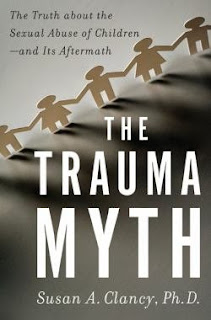
This book...this book...has been a long time coming. It says some things that really needed saying, but somehow I doubt they'll have the impact they should, which is tragic. It's very accessible, although not quite as meaty as I had hoped. Clancy recaps her grad school research on the experience of child sexual abuse as described by adult survivors. The dominant model holds that child sexual abuse is traumatic, and this trauma accounts for all the negative effects that frequently occur in the lives of abuse victims years later (such as depression). Trauma here means extreme fear, shock, violence, fear of bodily harm or death, etc rather than the more watered-down meaning it takes on in everyday conversation. So in the trauma model, one can expect the outcome of child sex abuse to be very similar to or identical with that of PTSD.
Of course, there's a political history behind this. Before child sex abuse became a form of trauma, it was widely dismissed or underestimated. Even worse, victims were often blamed and viewed as unnaturally mature and sexual, as seducers of their adult "partners" (think Lolita, here). Clancy notes that child advocates and feminists reacted strongly against this and pushed to change social views in order to get people to take child sexual abuse more seriously, procure funding for treatment and public awareness campaigns, etc. Unfortunately this went too far, and resulted in a tragic victim silencing of another sort.
It seems like there are two main forces at play in this dynamic. For one thing, those who are studying and treating victims of child sexual abuse are adults, and thus tend to understand sexual assault through an adult lens. In an adult understanding of the world, sexual assault most definitely is a traumatic experience. An adult has a much more complex understanding of sexual behavior, and a more fully developed sense of autonomy. But of course, children don't, so their immediate experience of sexual abuse is rather different from an adult understanding - and therefore experience - of it.
Second, the dominance of the PTSD model in other areas such as in the treatment of soldiers returning from war and adult survivors of sexual assault lent itself easily to the new push for protection, awareness, and treatment of sexually abused children. The PTSD train was already rolling with some pretty hardcore momentum, so it made sense at the time to hitch the child sexual abuse car to it. Except...
In the vast majority of cases, the trauma model doesn't fit. Only something like 14% of child sexual abuse cases involve violence, bodily harm, extreme fear, etc. In contrast, most are perpetrated by family members or close friends, and do not involve intercourse or penetration or physical force. The most common emotions experienced by the victims at the time are confusion and discomfort. But in our shared conceptual framework, child sexual abuse is generally the violent kind. This adds to the confusion of many victims, because they have a hard time conceptualizing it as abuse after the fact. They only hear the trauma model and are treated by therapists as if they were typical PTSD sufferers.
Thus the trauma model unintentionally adds to the victimization of survivors of child sexual abuse because they're left feeling like there is something really wrong with them because they didn't feel what they were supposed to feel. They didn't feel terrible fear or shock at the time, because they didn't really understand what was happening to them, and they weren't being physically threatened or harmed by the abuser. They didn't resist or run away, because at the time they didn't conceptualize it as abuse and had been taught to respect the authority of adults and therefore didn't see themselves as free to resist. But nobody tells them that this is actually a far more common abuse experience than the violent one sensationalized by the media and public advocacy campaigns. So it's like a double tragedy - that of being abused and having to spend the rest of your life sorting it out, and that of basically being silenced and alienated by the model we use to conceptualize the abuse and treat the victims. And I know that every word of this is true, because Susan Clancy, who has never met me, described my experience exactly.
Based on her research, Clancy advocates for a more realistic and effective approach. In the rare cases where force and violence did occur, the trauma model is fine. But in the more common case of non-violent coercion, the victims need most of all to hear that they're not alone, that many others have had the exact same experience, and that there is absolutely nothing wrong with them. This is normal. You are not fucked up, your abuser is. Your feelings and responses are totally normal, and your cooperation with something you did not understand and were not equipped to resist was totally understandable.
One would hope that in cases like this, actual interpersonal realities would trump political and economic concerns. One would hope that common sense and a desire to not silence or further victimize those who have been abused would be the driving force in the treatment of child sex abuse victims. One would hope. I'm not very hopeful. But I am very glad this book is out there.
So...I didn't really intend for this post to become a full-blown book review. It was supposed to be one of those quick li'l "this is what I'm reading what are ya'll reading" kind of posts. But the coffee's hot and the moon is full and the baby's sleeping sweetly on the couch and I just got a little carried away.
What are y'all reading these days? Anything good?
Environmental Toxins FTW!
This week Pediatrics published the results of a new study linking pesticides with ADHD. The abstract can be found here, and the following is an excerpt from the full article:
DISCUSSIONI cannot wait to hear the pesticide industry's response to this. I cannot wait to see what measures are taken by their representatives to prevent federal regulatory agencies and Congress from taking any action to limit our use of and exposure to pesticides. If it wasn't so sad it would be downright amusing.
We report an association between urinary DMAP metabolite concentrations, which are indicators of exposure to dimethyl-containing organophosphate pesticides, and increased odds of ADHD for children 8 to 15 years of age. There was a 55% to 72% increase in the odds of ADHD for a 10-fold increase in DMAP concentration, depending on the criteria used for case identification. This association was not explained by gender, age, PIR, race/ethnicity, fasting duration, or creatinine concentration. Whether DAP metabolite concentrations are more strongly associated with a specific subtype of ADHD is unclear, because of the small numbers of cases, although the association was stronger for the predominantly hyperactive/
impulsive subtype. This study should be generalizable to the US population because the NHANES sample is nationally representative, unlike previous studies of groups with higher exposure levels.11–15 With respect to the importance of these findings, organophosphates are among the most widely used pesticides, and the concentrations of DAP metabolites among children did not decrease from 2000 to 2003–2004.
Sunday, May 23, 2010
Comments
Let's start by saying I kind of hate comment moderation on blogs. It leads to stilted conversations and adds up to a lot of work for the blogger. Sometimes I'm up for a great conversation, and sometimes I want to just dump my thoughts out and leave them there. Having moderated comments makes you revisit old posts you're just sort of done with, and it ties you to your blog in a way that makes me slightly uncomfortable.
...but...
For the first time ever I've turned on the comment moderating feature here. And this is because I finally had to, after being cyberstalked and threatened by an Angry Entitled Asshole of a Commenter.
And blog etiquette seems to dictate that now I have to articulate a Comment Policy, right? If you're going to moderate comments, it's only fair that you clearly lay out what flies and what dies, it seems. The thing is, I'm not going to do that. Mostly because I don't want to, and forcing myself to do something that I won't enjoy and don't feel like I should have to do just sort of feels like doing homework. But also because this is my. fucking. space. and allowing a misogynistic entitled bullying asshole to come in here and force me to do things I don't want to do feels sort of ... out of line with feminist ideals, to say the least. Beyond that, I'm not sure why any blogger owes a Comment Policy to the public at large. If you're coming into my home, and your shoes are all muddy, and you demand an explanation of me when I ask you to take your fucking shoes off, then you're not really the kind of person I want in my house, anyway, so please leave. Now.
That's all.
Saturday, May 22, 2010
Tobacco products: totally not marketed to kids.
This message has been sent using the picture and Video service from Verizon Wireless!
To learn how you can snap pictures and capture videos with your wireless phone visit www.verizonwireless.com/picture.
Note: To play video messages sent to email, Quicktime@ 6.5 or higher is required.
This message has been sent using the picture and Video service from Verizon Wireless!
To learn how you can snap pictures and capture videos with your wireless phone visit www.verizonwireless.com/picture.
Note: To play video messages sent to email, Quicktime@ 6.5 or higher is required.
Friday, May 21, 2010
Wednesday, May 19, 2010
Score Card
Number of Catholic priests excommunicated for sexually assaulting young boys: 0
Number of Catholic nuns excommunicated for allowing an emergency life-saving abortion: 1
Also, when did Woody Allen become a bishop? Nobody tells me anything anymore.
Number of Catholic nuns excommunicated for allowing an emergency life-saving abortion: 1
Also, when did Woody Allen become a bishop? Nobody tells me anything anymore.
Tuesday, May 18, 2010
Sex and Religion and Moral Responsibility
Hopefully this post won't be as heavy as the title suggests.
First, a couple texts I wrote to a friend last night, motivated by recent events among my circle of friends in which certain people have behaved very badly:
In the first instance we have the romantic-love-as-spectator-sport that's so prevalent in romantic comedies and reality shows and wedding culture. And this has the odd effect of making people bystanders in their own relationships in a way. Just like the cultural preferencing of the male gaze leaves women constantly examining themselves from a harsh patriarchal stance (always watching ourselves perform femininity), the fetishization of hetero relationships, and a particular type of hetero relationship, causes many people to value the existence of a romantic relationship itself over the quality of their actual experience in that relationship. Which is not as clear as it sounded in my head. I'll try again. I think in our culture we (especially women) are so in love with the idea of being in love (and all the accouterments of romantic love), and so committed to the idea that there is no fulfillment outside of a romantic relationship, that we're willing to endure all kinds of ridiculous indignities for relationships that are ultimately unfulfilling, while we miss out on relationships that are potentially very fulfilling simply because we're not taken with the image of ourselves in those relationships. A friend said to me once "I'm not so sure I was in love with her. It was more like I was in love with the idea of myself as the guy who was in love with her." I think this is sort of what he was getting at. Anyway, this seems to be one cultural script we can follow when it comes to romantic relationships.
Then there's this other dynamic that's much more destructive. I have a number of acquaintances who can only manage to be attracted to someone if one or both of them are cheating. And a lot of lip-service is given to how wrong and shameful cheating is in this crowd, but really, most of it just seems to be lip-service. It's a script they've learned to appease a society that doesn't officially approve of cheating. But deep down, I suspect they don't feel that they've done anything wrong, or that they're responsible for the damage they routinely do to others. And I think this is due to another cultural script we have.
You see it all the time in movies and books. Two star-crossed lovers meet and are so attracted to each other instantly that they have to be together, no matter how many people they have to betray to do so. And it's passionate and intense and they're swept away by the experience. It's The Bridges of Madison County or the English Patient, in one form or another, over and over again. "This kind of certainty comes but once in a lifetime" and a whole lot of other ridiculous nonsense that sounds kinda like that. And the experience is epic and life-changing and soul-consuming. You become more fully yourself when you're with this person, whatever that means: "I was acting like another woman, yet I was more myself than ever before." Well, you were acting like a treacherous asshole, so apparently that's who you really and truly are. And this person helped you discover that, and that's a good thing?
Except that in the end it isn't epic and life-changing and soul-consuming, and the passion burns out and you're left with a couple of inconsiderate schmucks who just fucked up a lot of people's lives. But the thing is, the experience is constructed (and no doubt experienced) as this thing that's bigger than you, bigger than the two of you. It's this Force of Nature, and you're just a helpless leaf caught up in the whirlwind of it all. And leaves don't have agency. Moral responsibility cannot be attributed to mere leaves. So you are excused of all wrong-doing.
But the experience is transformative in other ways, right? You become this new person within the body of the illicit relationship. You're passionate and poetic and so special and unique that you're totally worth taking huge risks for. It's exciting and an escape from everyday life. And it sets you apart, because the same rules that apply to ordinary people don't apply to you. If someone suggests that the rules do apply to you, you dismiss them with a sneer, thinking that they've just never experienced the depth of passion you're experiencing (or something along these lines). If your bf/gf/husband/wife/partner, who you're cheating on at the time, were to cheat on you, you would be outraged and wounded. But this is not hypocrisy, because in this script you are special - the rules don't apply to you - while they are ordinary people and thus governed by the laws of convention.
And what does all of this sound just exactly like? Religious experiences. A transcendental reality. Epic, transformative, irresistible, intense. So I suppose in this framework, being in the grip of a religious experience exempts one from moral responsibility as well. Think Abraham sacrificing Isaac here (sorry Kierkegaard, I think I just finally really got this, because, seriously, I was way too young when I first read you anyway). And maybe the chronic cheaters are looking for the
transformative religious experience that's a perennial object of obsession in our culture. But dontcha think by now we should get over the whole immature "I need to be swept off my feet and have a transformative (change you can believe in) experience or I'm just standing outside the fire and missing out on the real experiences" thing and realize already that love is what you do, not what you feel in the moment that will change in a heartbeat, and that mature people live with their feet on the ground and their loved ones' best interest in their heads at all times, not just when it feels good? In other words, Jesus Christ I am sick to death of immature self-absorbed people. But also, this is another way in which the ridiculous cultural scripts and expectations we cling to are much more than harmless entertainment, and do very real damage to real people in the real world.
First, a couple texts I wrote to a friend last night, motivated by recent events among my circle of friends in which certain people have behaved very badly:
I’m thinkin: Some people (name redacted, e.g.) go from one bad relationship to another because they’re in love with being in love. They’re taken with the image of themselves with wind in their hair being gazed at adoringly. Others cheat incessantly because they’re taken with the idea of an attraction so intense it defies convention and exempts them from the rules that ordinary mortal folk have to follow. I’m not sure where the rest of us stand.
And later:
The “swept off your feet” phenom exempts one from moral responsibility, right? When you’re in the grip of something so much bigger than yourself… So it seems that you and [mutual friend’s] ladyfriend have this in common. It just takes on a dif form. And it fits the description of a religious experience…in the grip of an epic force in which you are transformed from the ordinary. Ecstasy. The drug. The religious experience. The orgasm. Whatever.
So I've been thinking about this in more detail as it applies to a broader pattern of behavior and not just to certain people I know.
In the first instance we have the romantic-love-as-spectator-sport that's so prevalent in romantic comedies and reality shows and wedding culture. And this has the odd effect of making people bystanders in their own relationships in a way. Just like the cultural preferencing of the male gaze leaves women constantly examining themselves from a harsh patriarchal stance (always watching ourselves perform femininity), the fetishization of hetero relationships, and a particular type of hetero relationship, causes many people to value the existence of a romantic relationship itself over the quality of their actual experience in that relationship. Which is not as clear as it sounded in my head. I'll try again. I think in our culture we (especially women) are so in love with the idea of being in love (and all the accouterments of romantic love), and so committed to the idea that there is no fulfillment outside of a romantic relationship, that we're willing to endure all kinds of ridiculous indignities for relationships that are ultimately unfulfilling, while we miss out on relationships that are potentially very fulfilling simply because we're not taken with the image of ourselves in those relationships. A friend said to me once "I'm not so sure I was in love with her. It was more like I was in love with the idea of myself as the guy who was in love with her." I think this is sort of what he was getting at. Anyway, this seems to be one cultural script we can follow when it comes to romantic relationships.
Then there's this other dynamic that's much more destructive. I have a number of acquaintances who can only manage to be attracted to someone if one or both of them are cheating. And a lot of lip-service is given to how wrong and shameful cheating is in this crowd, but really, most of it just seems to be lip-service. It's a script they've learned to appease a society that doesn't officially approve of cheating. But deep down, I suspect they don't feel that they've done anything wrong, or that they're responsible for the damage they routinely do to others. And I think this is due to another cultural script we have.
You see it all the time in movies and books. Two star-crossed lovers meet and are so attracted to each other instantly that they have to be together, no matter how many people they have to betray to do so. And it's passionate and intense and they're swept away by the experience. It's The Bridges of Madison County or the English Patient, in one form or another, over and over again. "This kind of certainty comes but once in a lifetime" and a whole lot of other ridiculous nonsense that sounds kinda like that. And the experience is epic and life-changing and soul-consuming. You become more fully yourself when you're with this person, whatever that means: "I was acting like another woman, yet I was more myself than ever before." Well, you were acting like a treacherous asshole, so apparently that's who you really and truly are. And this person helped you discover that, and that's a good thing?
Except that in the end it isn't epic and life-changing and soul-consuming, and the passion burns out and you're left with a couple of inconsiderate schmucks who just fucked up a lot of people's lives. But the thing is, the experience is constructed (and no doubt experienced) as this thing that's bigger than you, bigger than the two of you. It's this Force of Nature, and you're just a helpless leaf caught up in the whirlwind of it all. And leaves don't have agency. Moral responsibility cannot be attributed to mere leaves. So you are excused of all wrong-doing.
But the experience is transformative in other ways, right? You become this new person within the body of the illicit relationship. You're passionate and poetic and so special and unique that you're totally worth taking huge risks for. It's exciting and an escape from everyday life. And it sets you apart, because the same rules that apply to ordinary people don't apply to you. If someone suggests that the rules do apply to you, you dismiss them with a sneer, thinking that they've just never experienced the depth of passion you're experiencing (or something along these lines). If your bf/gf/husband/wife/partner, who you're cheating on at the time, were to cheat on you, you would be outraged and wounded. But this is not hypocrisy, because in this script you are special - the rules don't apply to you - while they are ordinary people and thus governed by the laws of convention.
And what does all of this sound just exactly like? Religious experiences. A transcendental reality. Epic, transformative, irresistible, intense. So I suppose in this framework, being in the grip of a religious experience exempts one from moral responsibility as well. Think Abraham sacrificing Isaac here (sorry Kierkegaard, I think I just finally really got this, because, seriously, I was way too young when I first read you anyway). And maybe the chronic cheaters are looking for the
transformative religious experience that's a perennial object of obsession in our culture. But dontcha think by now we should get over the whole immature "I need to be swept off my feet and have a transformative (change you can believe in) experience or I'm just standing outside the fire and missing out on the real experiences" thing and realize already that love is what you do, not what you feel in the moment that will change in a heartbeat, and that mature people live with their feet on the ground and their loved ones' best interest in their heads at all times, not just when it feels good? In other words, Jesus Christ I am sick to death of immature self-absorbed people. But also, this is another way in which the ridiculous cultural scripts and expectations we cling to are much more than harmless entertainment, and do very real damage to real people in the real world. Thursday, May 13, 2010
Sunday, May 9, 2010
Happy Birthday to the Pill
And happy Mother's Day.
Lyrics:
You wined me and dined me
When I was your girl
Promised if I'd be your wife
You'd show me the world
But all I've seen of this old world
Is a bed and a doctor bill
I'm tearin' down your brooder house
'Cause now I've got the pill
All these years I've stayed at home
While you had all your fun
And every year thats gone by
Another babys come
There's a gonna be some changes made
Right here on nursery hill
You've set this chicken your last time
'Cause now I've got the pill
This old maternity dress I've got
Is goin' in the garbage
The clothes I'm wearin' from now on
Won't take up so much yardage
Miniskirts, hot pants and a few little fancy frills
Yeah I'm makin' up for all those years
Since I've got the pill
I'm tired of all your crowin'
How you and your hens play
While holdin' a couple in my arms
Another's on the way
This chicken's done tore up her nest
And I'm ready to make a deal
And ya can't afford to turn it down
'Cause you know I've got the pill
This incubator is overused
Because you've kept it filled
The feelin' good comes easy now
Since I've got the pill
It's gettin' dark it's roostin' time
Tonight's too good to be real
Oh but daddy don't you worry none
'Cause mama's got the pill
Oh daddy don't you worry none
'Cause mama's got the pill
Subscribe to:
Posts (Atom)